


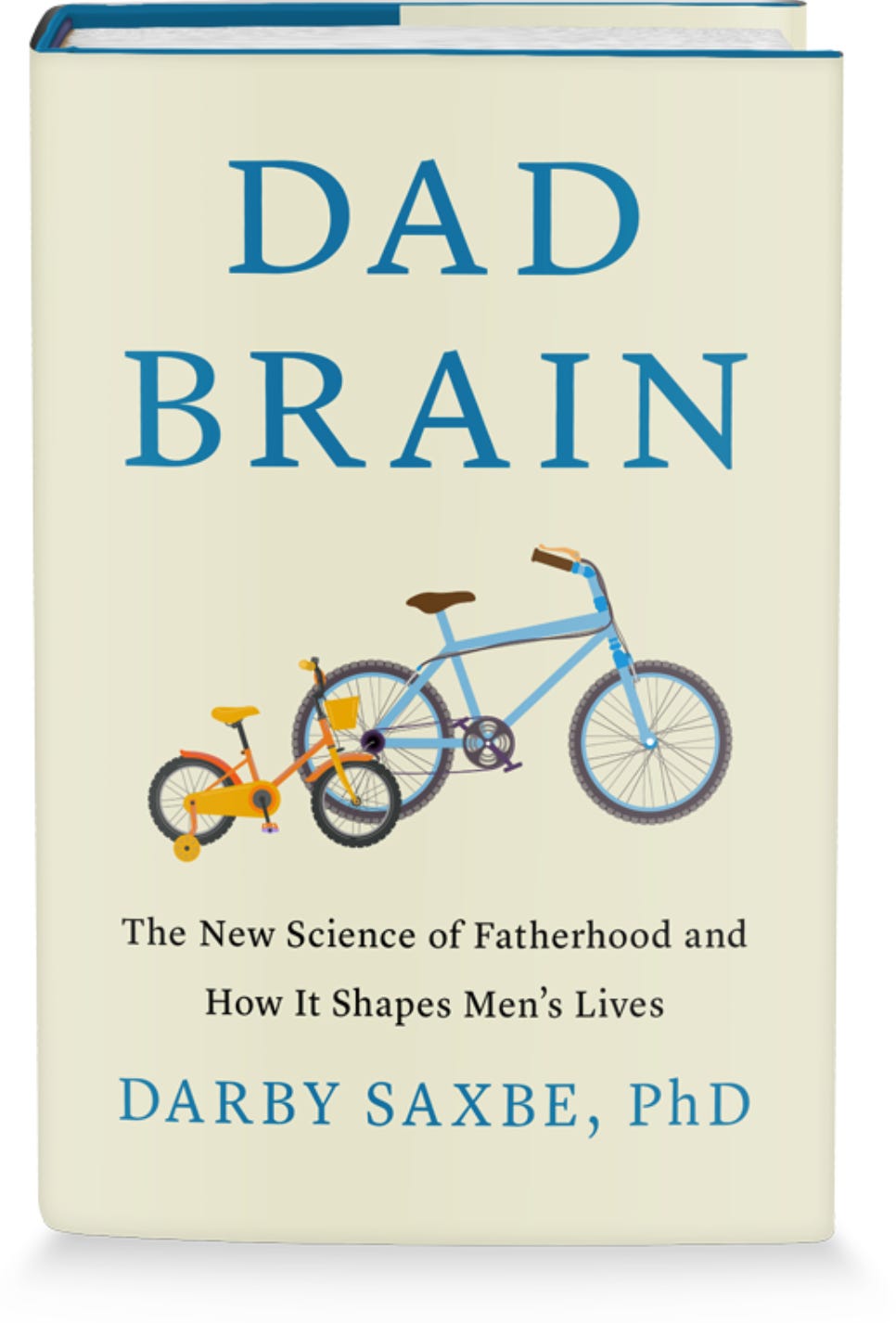
I’m a huge fan of Darby Saxbe’s research, her Substack, and her forthcoming book. (As a new dad myself—see here—the topic of what happens to dads’ brains is irresistible.) So I’m proud to host this guest post on how parenting influences our empathy.
—Paul Bloom
Darby Saxbe is a professor of psychology and neuroscience at the University of Southern California and the author of the book Dad Brain: The New Science of Fatherhood and How it Shapes Men’s Lives, which is out June 9 (pre-order it now!). This guest essay is lightly adapted from the final chapter of her book, “Fatherhood and the Good Life.”
Does having children make us more empathic? In many ways, that’s an easy yes: As a parent, you spend most of your time trying to satisfy the wants and desires of a small needy person who can’t yet communicate clearly with you. If you’ve ever puzzled over why a baby is upset and cycled through half a dozen ways to comfort them, you’ve done intensive mentalizing work. Many of our social interactions have a transactional component: We do favors hoping that others will return them in the near future. We scratch other people’s backs and they scratch ours. But as parents, we prepare food, change diapers, and wake up in the middle of the night for the benefit of a child who will not be able to reciprocate that care for decades, if ever. What could be more selfless than that?
Indeed, some scientists, like Israeli psychologist Ruth Feldman, have argued that our very notion of empathy originates from the evolutionary foundations of parenthood. Because our offspring need such intensive care, we humans have developed social brains that monitor each other’s signals and extend compassion to the vulnerable. As Feldman has written, the human parental brain did not evolve by adapting brain structures that perform complex social cognition to work in parents. Rather, we evolved these structures as parents first, to maximize the chances that our infants would survive. These adaptations, per Feldman, transformed our brain capacities “from the automaticity of mammalian caregiving to the flexibility of human parenting by evolving structures that can represent others’ states in one’s brain (embodied simulation), resonate with nonverbal signals (empathy and mentalizing), and hierarchically organize tasks (emotion regulation) to safeguard infants from harm.” In short, Feldman concludes, “the human did not foreshadow the parent but rather the parent prefigured the human.” Our human minds come equipped with sophisticated social cognition abilities because we had to be able to care for each other in order to survive.
However, becoming a parent is also profoundly selfish, because it concentrates our focus on our own genetic kin and motivates us to favor our children over everyone else. Some of the biggest resource hoarders in our society are parents who will stop at nothing to get a leg up for their child, whether that means gaming the system to get them into the “right” preschool or the top university, with no compunction about taking opportunities from another, perhaps more deserving, child. I teach at the University of Southern California, which became the epicenter of the “Varsity Blues” scandal in 2019. The scandal exposed 33 parents – including multiple celebrities –as having bribed coaches and falsified their children’s athletic profiles in order to gain admission to USC. They went to such extremes as Photoshopping a child’s head onto a water polo player and making up a fake rowing team profile for a girl who’d never set foot on a scull.[1] At the time that the scandal broke, I was mostly pleased to hear that my university had become desirable enough to drive our country’s greatest thespians (not to mention a Hot Pockets heiress) to crime. Now, as the parent of a soon-to-be high school senior, I am ready to break out the Photoshop to get my own kid ahead.[2] Even as we sacrifice everything for our individual children, parenting can drive us to be greedier and more competitive with others. So parenting can, ironically, make us more self-interested at the same time that it makes us more selfless.
The Stanford University empathy researcher Jamil Zaki wrote in The Atlantic that after having his own daughter, he noticed his own perspective shift. He became less annoyed by crying children on airplanes but more suspicious of strangers. He observed two kinds of changes: “First—and this one is easy—I feel empathy for my child on a scale I’ve never experienced before. Second, I can feel my empathy for others sometimes diminish in her presence.” As humans, we tend to split the world into in-groups (ourselves and our tribe) and out-groups (everyone else). The arrival of a child can sharpen the distinctions between these groups and engender what empathy experts call “parochial altruism.” As Zaki put it, “The moment she was born, our daughter created a new group: my children. Just as suddenly, everyone else joined another group: not my children. Family, the most powerful and smallest us to which most people belong, carpets the world in a vast, undifferentiated them. This boundary can dampen our empathy for outsiders, especially when they might imperil our own tiny tribe.”
The “might imperil” piece is key. In his Atlantic essay, Zaki cites a 2014 study in which the researchers approached Tel Aviv mothers on the street and asked them to rate their sympathy to Eritrean refugees, after showing them newspaper clippings that either highlighted the potential threat posed by the refugees or the challenges faced by the refugees. When mothers in the “threat” condition were accompanied by their child, they expressed more animosity towards the refugees and more willingness to endorse anti-immigration policies. In other words, the researchers found that the mix of threat and caregiving was particularly potent in engendering hostility to outsiders.
Along similar lines, although we think of breastfeeding as a particularly cozy and serene activity, research in both animals and humans finds that lactation increases maternal aggression, because nursing mothers become especially hypervigilant to threats that might harm their infants.
However, Zaki’s research also finds that empathy can be nurtured and fostered; it’s a skill, not a trait. Parents can choose to deploy their caregiving energies in prosocial directions. Go to a PTA meeting or a town council hearing and you’ll often find people who are inspired by parenthood to take a greater interest in their local communities.
Whether parenthood is selfish or selfless ultimately depends on larger structural conditions. A competitive, individualistic society with a winner-takes-all economy pits parents against each other, but we can dream about a society that treats child-rearing as a collective enterprise and invests in policies that benefit every kid. For every story of a parent pushing their child’s interests ahead of others, there is a story of someone who was inspired by their child’s birth to care more about the fate of other children across the globe.
[1] I have also never set foot on a scull, so hopefully I got the right boat name there.
[2] I’m joking, of course! I would go straight to Canva.
"Zaki wrote...he noticed his own perspective shift"
In the days after my first arrived, the protective instinct felt like a full brain rewiring. My wife's mom gave us a break for a day, and this thought kept sneaking in like a hiss "she's taking the baby...she's taaakking the baby...", it felt like going insane. Maybe some of it was sleep deprivation, but be careful around new parents.
One of the most interesting insights here is that parenthood doesn't simply make us more empathic, it changes the scope of our empathy. The challenge is whether our concern remains confined to "my child" or expands into a deeper commitment to the wellbeing of all children and future generations. The best parents often seem to make that transition. Raising children teaches patience, sacrifice, responsibility, and service, but it can also inspire broader civic engagement, mentoring, volunteering, and community leadership. Perhaps the ultimate test of parenthood is not only how well we care for our own children, but whether that love enlarges our sense of responsibility for other families, other children, and the society they will inherit...