


(This is a lightly revised version of a post originally sent to paid subscribers.)
—
“Nobody can touch you without your consent” seems right. When I entered the phrase into Google, the AI stated that it was
fundamentally correct and a core principle of bodily autonomy, personal boundaries, and law.
Critically, it’s current consent that matters. Someone can agree ahead of time (even enthusiastically agree) to sex or surgery, but if they change their mind the moment the contact is about to happen, their choice must be respected.
This principle does not always apply, though. Exploring those cases where it doesn’t hold can tell us some interesting things about how we think about autonomy and morality.
For starters, this principle doesn’t apply to everyone. Parents manhandle their children all the time—sometimes for their own good, as when the kid is trying to stick his fingers into an electrical socket, but sometimes for the parents’ convenience, like when forcing a screaming toddler into a car seat because you have to take her home from the supermarket. Children do not have the autonomy rights that the principle assumes.
You can override this principle in emergencies. If you yank someone onto the sidewalk if they’re about to be creamed by an oncoming truck, that’s totally fine.
You can use force to keep your drug-tripping friend from jumping out a window or your drunk neighbor from getting into his car. (Maybe in some relevant sense, these individuals become like children.)
You’re allowed limited contact with strangers. You can gently tap someone on the elbow (but not the butt) to get them to move aside on the moving walkway.
The principle doesn’t apply to those who commit certain immoral/illegal acts. If someone is attacking you or another person, you are permitted to touch them. And law enforcement officers—and sometimes regular people—can touch someone against their will to keep them from committing a crime or escaping from the scene of a crime. In old movies, a man grabs a woman’s purse and runs away; there is a scream, someone shouts, “Stop, thief!”, and the man is chased and tackled to the ground, very much without his consent—but while the thief doesn’t like it, I bet he doesn’t feel morally wronged.
There are many questions that these exceptions and related ones raise. (When does a child get old enough to acquire autonomy rights? What sorts of crimes are tackle-worthy?) But I’m more interested in cases like this:
Someone is trying to touch me, and I really don’t want them to. I move away and try to hit the person to make them stop. They touch me anyway.
Have they done something wrong? Not necessarily. Have you ever boxed? In boxing, someone tries to punch you—often right in the kisser! When boxing, you don’t want to be punched, not even a little bit, and you try very hard to avoid it. It’s unwanted physical contact if anything is.
This isn’t a true counterexample to the principle, though. The main difference between a boxing match and a violent assault (other than the gloves) is that, for boxing, you agreed to enter a situation in which this unwanted touching happens. You don’t want to be hit, but you have consented to being hit. A less violent example of unwanted touching is tag, where the whole goal is not to be touched, and yet you agree to letting people try.
Boxing and tag fall within a broader category of sports and games in which participants consent to the possibility of experiencing unwanted events. I’ll be unhappy if you take my queen, sink my battleship, or call my bluff—and I’ll work hard to keep these events from happening—but such activities are only fun if these negative outcomes are possible, and so I consent to them.
Then there’s sex. Cartoons Hate Her has a good discussion of consensual non-consent (CNC)
which can range from something as edgy as full rape role-play parties with strangers, or something as seemingly normie as granting your accountant husband of twenty years 24/7 access to your body, buffered only by a safe word.
The sports cases and the sex case are different in an interesting way. In boxing, the possibility of being touched is a necessary evil; the best outcome is that you go into the ring, pummel your opponent into submission, and never get a glove laid on you. For CNC, the “non-consensual” touching is part of the fun. (The accountant husband who gallantly respects his wife’s space is missing the point.) In boxing, the resistance is genuine; in CNC, it is (some of the time? partially? read the linked article for discussion) feigned.
What sports and sex have in common is an insistence on current consent. There’s always a safe word in CNC. For the grappling martial arts, the match stops immediately when someone taps their opponent or slaps the mat. There is no agreed-upon safe word for boxing—consent isn’t usually withdrawn in the middle of a bout—but you can stop a match. The most famous example of this is the 1980 fight between Sugar Ray Leonard and Roberto Durán, in which Durán gave up in the 8th round by telling the referee, “No más” (Spanish for “no more”). You can see it below; go to minute 32.
I have some true counterexamples coming up, but consider first the question: Why do we put so much value on current consent? Why not past consent?
The philosopher Meghan Sullivan explores this issue in her book “Time Biases: A Theory of Rational Planning and Personal Persistence.”1 Sullivan thinks many of us do poorly in life because we are “time-biased”—we have unwarranted preferences about when events should occur. Maybe you have a “near bias”: you eat the popcorn just before the movie starts, even though you would probably enjoy it more if you waited. Or maybe you have a “structural bias,” preferring your experiences to have a certain temporal shape: you plan your vacation such that the best part comes at the end.
For Sullivan, all of these time biases are mistakes. She advocates for temporal neutrality—a habit of mind that gives equal weight to the past, present, and future. She argues that a rational person prefers that “her life going forward go as well as possible”, and so a rational person’s preferences “are insensitive to arbitrary differences.” Temporal differences are, in her mind, arbitrary.
She has a neat example of how this principle clashes with the notion that the priorities of one’s “present self” matter the most. Imagine, she writes, that you have trained for a triathlon for many months. Now it’s race day. The weather is fine, you’re healthy, but you just don’t feel like participating. Suppose you’re fairly certain that, if you don’t participate, you won’t regret your choice in the future. Should you race, even though you don’t feel like it?
Sullivan says that you should. She argues that you have no reason to take your current goals more seriously than your past ones. “The mere fact that planning was done in the past is no reason to ignore it now,” she writes.
Sullivan isn’t talking about consent here, but I will. The conclusion that her theory leads to (which I’m not endorsing, not yet anyway) is this: Suppose you care about someone. You have their interests in mind; you want their life to be, overall, as good as possible. If so, and if they are time-biased, you should sometimes override their current preferences. They probably won’t be happy with this, and this unhappiness has to be considered when deciding whether to violate their current consent. But if the overall positive gain to their lives outweighs this momentary negative, the right thing to do is to force them.
Such a violation of consent for someone’s own good is sometimes called paternalism, and it has its champions, such as the philosopher Jason Hanna, in his book In Our Best Interest: A Defense of Paternalism.2
There’s one type of paternalism that everyone is comfortable with—being paternalistic about one’s own future actions. That is, we sometimes think about what we will want to do in the future, realize that it’s not in our own best interests, and act now to try to block that future bad decision (which, at the time, will be the current bad decision) from happening.
Examples: Dieters buy food in small portions so they won’t overeat later on. Smokers trying to quit tell their friends never to give them cigarettes, no matter how much they may later beg. In her book on gluttony, Francine Prose tells of women who phone hotels where they are staying to demand a room with an empty minibar. My son once had a terrible time getting up in the morning, so we bought him an alarm clock that rolls away as it sounds; to shut it off, he had to jump out of bed and find the damn thing. At 11:55, I know I’ll be tempted to check my phone during the noontime talk I have to go to, and since I want to engage with the ideas and be respectful to the speaker, I leave it in my office. At 12:10, bored out of my skull and wishing that I could check my email and play Spelling Bee, I’m bitter about my past choice to thwart my current desires.
Sometimes we enlist others to help block our future bad desires. Take the classic story of Odysseus and the sirens.
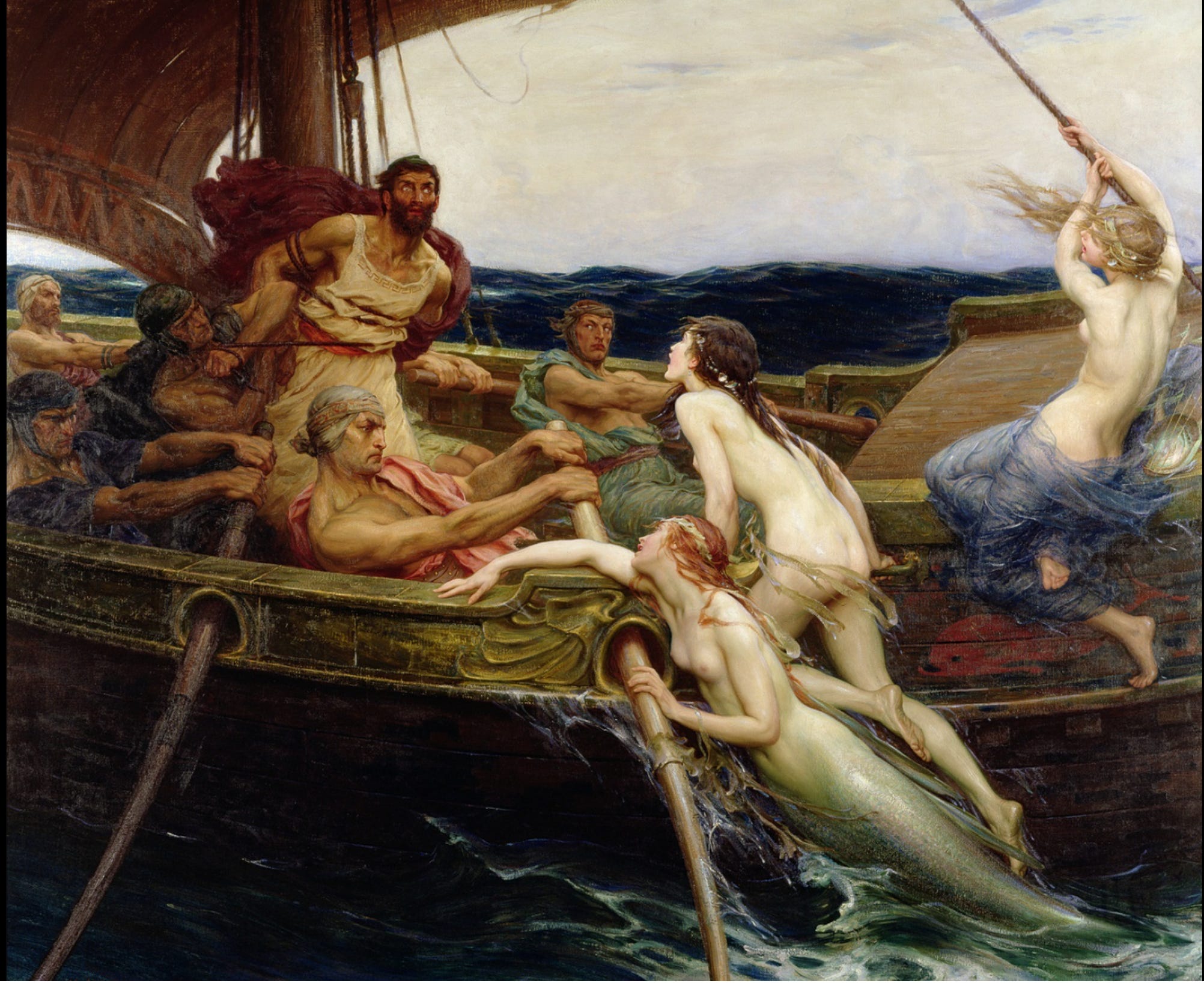
Odysseus wants to hear the song of the Sirens, but doesn’t want them to lure him into the sea. And so he instructs his men to put beeswax into their ears and bind him to the mast. He adds:
If I beseech you and command you
to set me free, you must increase my bonds
and chain me even tighter.
He does beseech them, and the men follow his earlier instructions.
Their song was so melodious, I longed
to listen more. I told my men to free me.
I scowled at them, but they kept rowing on.
Eurylochus and Perimedes stood
and tied me even tighter, with more knots.
But when we were well past them and I could
No longer hear the singing of the Sirens,
I nodded to my men, and they removed
the wax that I had used to plug their ears,
and untied me.
Odysseus isn’t the slightest bit upset at his men for disobeying his orders and not freeing him3, and no reader has ever thought that his men should be punished. So much for current consent.
In a classic article written 40 years ago (Self-Command in Practice, in Policy, and in a Theory of Rational Choice), Thomas Schelling gives a series of examples of ways we might implore others to help restrain the choices of our future selves.
Please do not give me a cigarette when I ask for it, or dessert, or a second drink. Do not give me my car keys. Do not lend me money. Do not lend me a gun. …. Do not let me go back to sleep. Interrupt me if I get in an argument. Push me out of the plane when it’s my turn to parachute. Don’t let me go home drunk unless you can remove my children to a safe place. Blow the fuse if you catch me watching television. Make me get up and do my back exercises every morning. Keep me moving if I am exhausted in the wilderness.
This is a diverse set of examples. Some are unproblematic from a moral view. Take “Please do not give me a cigarette when I ask for it”.
-Hey, Paul, pass me a cigarette.
-Sorry, Joe. You told me a while ago you’re quitting.
-Well, I’ve changed my mind. Hand it over.
-No, you told me not to.
-I changed my mind, dammit.
-Sorry, no.
We can argue whether I’m being a good friend (I think yes), but there’s no sense in which I’m violating Joe’s consent. It’s my cigarette; it’s up to me whether I give it to him. Yes, I’m being paternalistic, but if so, it’s a benign sense of paternalism.
Now consider “Push me out of the plane when it’s my turn to parachute.”
-I’ve changed my mind, Paul. I’m not jumping.
-Sorry, Joe. You told me to push you. [Push]
-STOP THAT! I’m not jumping.
-[Push]
-STOP THAT! I DON’T WANT TO JUMP! I CHANGED MY MIND! STOP PUSHING!
-[Push]
This seems different. I’m putting my hands on him, against his current wishes. Is this okay? I’m not sure, so here’s a poll.
Are there cases in which it’s morally permissible to violate someone’s current consent even without their prior agreement? Sure. If someone hears terrible news and, on impulse, tries to jump out of a window, the right thing to do is to try to stop them. Or consider this case, from Schelling.
A few years ago I saw again the original Moby Dick, an early talkie in black and white. There was a scene—not in the book—of Ahab in the water losing his leg, and immediately afterward below deck under a blanket, eating an apple with three of the crew. The blacksmith enters with a hot iron to cauterize the stump. Ahab begs not to be burned. The crewmen hold him down as he spews out the apple in a scream, and steam rises where the iron is tormenting his leg. The movie resumes with Ahab out of pain and apparently glad to be alive. There is no sign that he took disciplinary action against the blacksmith or the men who held him while he was tortured.
Ahab is very much touched without his consent. He’s not a child, he’s not drunk. And it’s not like the previous cases where he expressed a prior desire to be restrained. He’s not Odysseus.
Do you think the men did the right thing?
Suppose you agree that they did the right thing. (For what it’s worth, this is my view, and Schelling’s too.) What makes it right—why do we see it as okay, in this case, to touch someone without their consent? I see two possibilities.
Best Interests. In certain extreme cases, we see it as morally right to act in a person’s best interests, even if it goes against what they want. The qualification is needed here—I might think it’s in your best interests not to eat so much processed food, but it’s not acceptable for me to smack a croissant out of your mouth. But in the Ahab case, he will likely die unless he is restrained, and this is enough to make this intervention not only morally acceptable, but, in the eyes of some people, morally obligatory.
Unsound Mind. Maybe we’re only allowed to intervene because Ahab isn’t in his right mind. Admittedly, the story doesn’t explicitly say this, there’s just:
Ahab begs not to be burned.
But the way I imagine it, he’s screaming in terror, and in this (understandably) panicked state, his wishes matter less. This intuition that you can sometimes touch someone without their consent if they’re not in their right mind is codified in law. If an adult says that they don’t want medical treatment, even if the treatment is life-saving with no risks, doctors are forbidden from treating them. But if the person is delirious, intoxicated, confused from blood loss, etc., there is a shift to a standard of “implied consent". This standard applies when doctors arrive on the scene of an accident and treat someone who is unconscious—they assume that if they were conscious, they would consent. Similarly, they will treat someone who is delirious and screaming that they don’t want to be touched, under the assumption that if this person were in a rational state, they would want to be treated.
Maybe, then, when we think the men were right to hold Ahab down, we think of Ahab as being (as the expression goes) mad with fear. And so his consent isn’t needed. The same logic applies to a case raised earlier.
If someone hears terrible news and, on impulse, tries to jump out of a window, the right thing to do is try to stop them.
And, of course, it applies to Odysseus, who is under the spell of the Sirens.
We can think of these theories as competing accounts of common-sense morality, and it’s clear they differ in interesting ways.
Best Interests gives some weight to what a person wants (people are upset when their wishes are ignored, and it’s wrong to upset people), but this is just one consideration among many, and if the stakes are high enough, a person’s most sincere and deliberated decisions can be overridden—by force, if necessary. This is a paternalistic view.
In contrast, the Unsound Mind account is consistent with the view that personal autonomy is sovereign, and for an adult of sound mind, you can never override it. The only cases where it’s right to touch a person without their consent are instances in which we assume the person is, as we sometimes put it, “not themselves”.
These theories make different predictions. Consider Ahab again. The original story includes
[Ahab is] below deck under a blanket, eating an apple with three of the crew. The blacksmith enters with a hot iron to cauterize the stump. Ahab begs not to be burned.
Consider now this modification.
Ahab is below deck under a blanket, eating an apple with three of the crew. He turns to them and says calmly, “Look, I’ve been a captain for a long time, and I know how this goes. The blacksmith is going to arrive to cauterize my wound. But I don’t want this. It’s extremely painful. On balance, I’ll take the chance of infection. So I’m ordering you not to burn me.”
Notice that in both cases, it’s in Ahab’s best interests to cauterize the wound. Paternalism says: Do It. But if these cases feel different to you—if you are less inclined to approve touching Ahab without his consent in the case where he is calm—then this favors the Unsound Mind theory.
I find this issue fascinating, and Joshua Confer and I are beginning a series of studies exploring it, asking about the circumstances under which ordinary people sometimes think it’s acceptable to touch someone without their consent.
Some of this section is drawn from my New Yorker article, Being in Time.
Thanks to Joshua Confer for recommending this book to me, for our many productive discussions of these issues, and for his comments on an earlier draft of this piece.
Christina Starmans pointed out something weird about this story—if the men had beeswax in their ears, how could Odysseus “command [them] to set him free”? What could he mean when he said: “I told my men to free me”? Perhaps Odysseus had a very expressive face? Or maybe his men were lip readers?
I think this is a difficult question because if another person's past determination is dissonant with their current will, they will be mad at you at some point regardless of what decision you make.
Take the tobacco example. If you give them their tobacco because you value the "current will" more heavily, they could be mad at you afterwards, saying that you ruined their plans on refraining from smoking. But if you deny them their tobacco because you value the "past determination" more heavily (and think that they would regret it afterwards if they did end up smoking), although they could be grateful to you afterwards, they would still scream at you at the moment for not giving them their tobacco.
I am aware that other situations could be more complicated, but even with the parachute example, you could never truly know if the other person is genuinely changing their mind, or is simply chickening out at the moment and would regret not parachuting down the plane afterwards. Therefore, there is not much of an "optimal decision" you can make.
I think the best way to handle these situations is to ask the other person beforehand, "What should I do if you change your mind at the moment?" Because you are asking them when they are presumably in a calm and rational state, you are able to get a finalized confirmation on what you should do when they do change their minds later on. This way, it is now the other person who is being held accountable for their own decisions.
I believe this can also apply to your own thoughts and decisions when you are the one enlisting others for paternalism, as you are given an opportunity to ask yourself twice before committing to a plan and holding yourself responsible for your choices.
This is a great set of questions, questions that are often being discussed in Emergency Departments of hospitals in particular. I think many people would do well to consider them more often and in more depth than they currently do.
Also - the 'tapping' equivalent for boxing is taking a knee, you can drop to a knee at any point and the referee will pause the fight for an 8 count.