


[This is a reposting of something I wrote just when I started Small Potatoes. I’ve substantially edited and revised it, but kept some of the old-timey examples.]
—
Everybody knows the problem with the feedback system of social media sites. The system of likes, reposts, restacks and the like encourages mobbing, clickbait, and other bad behaviour. Jonathan Haidt talks about this in an Atlantic article.
One of the engineers at Twitter who had worked on the “Retweet” button later revealed that he regretted his contribution because it had made Twitter a nastier place. As he watched Twitter mobs forming through the use of the new tool, he thought to himself, “We might have just handed a 4-year-old a loaded weapon.”
I agree with much of what Jon writes here, but I want to talk about a less serious issue with the feedback system, one that only affects a small group of people. But who knows, maybe you’re one of the people this applies to, and then this post will be useful, maybe life-changing!
Consider five sorts of posters. For the first three, the feedback system provides accurate information.
Those who say nice things

I’m thinking of popular posters like Steve Martin (4.5 million followers when he posted the one above), who write posts that make people laugh or go awwwwww. And I’m also thinking of the small fry who use social media to congratulate students and colleagues on accomplishments or provide information and opinions on low-controversy topics, like, I don’t know, pretty sunsets they’ve seen or writers that are obscure but really do a great job.
These people can count up likes, retweets, restacks, and responses, and use this as a rough measure not just of how many people engaged with their post, but also of how many people liked it, in the original sense of “liked”—having positive feelings about it. The two measures (engagement and liking) are very similar.
Verdict: ACCURATE.
Controversialists (edgelords, shitposters, etc.)
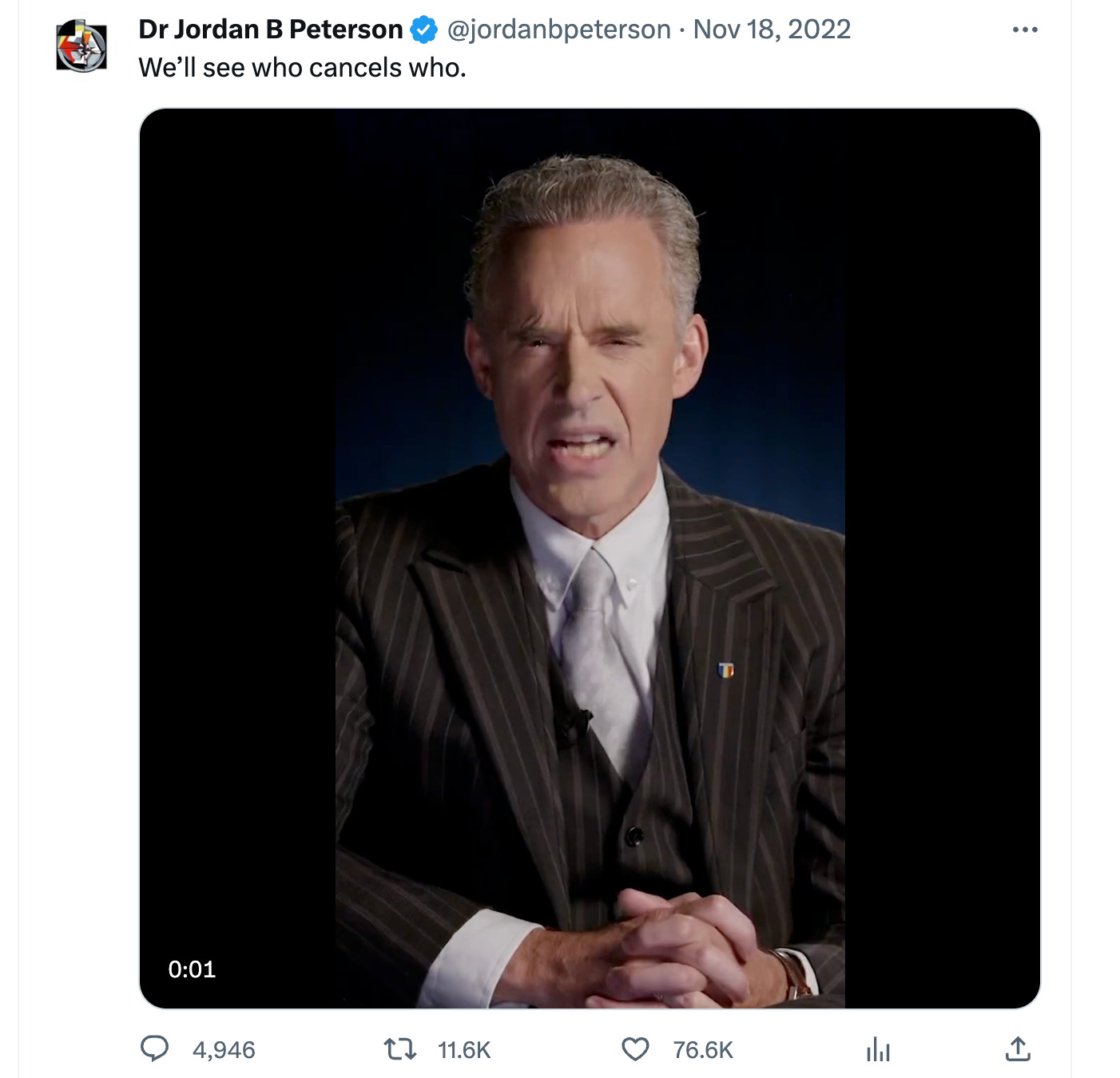
Take Jordan Peterson, who, when he posted this, had about the same number of followers as Steve Martin. (For health reasons, he’s been off social media for the last several months.) A lot of his posts are controversial, and he intends them to be. He can calculate engagement with his tweets just as Steve Martin does, by counting likes, reposts, and so on.
He can also get a fairly accurate sense of how many people think his tweets are stupid, cruel, and ignorant because they will tell him. They will reply to him with nasty remarks; they will repost his tweets with derisive or mocking comments. If he wants to tweak the offensiveness of future tweets, he has plenty of information about which topics and presentation styles enrage people the most.
Verdict: ACCURATE.
The Accidentally Famous
There are cases where an otherwise normal social media user goes viral, such as the father who posted a lengthy thread about how he refused to open a can of baked beans for his daughter, insisting that she figure out how to use a can opener by herself.

When the reaction is negative, as it was for “Bean Dad”, the poster will learn this by being deluged with hateful comments, getting death threats, losing their job, and so on.
When, less frequently, the reaction is positive, the poster will learn this by getting praise, job offers, and, in one case, having their tweets turned into a television series.
Verdict: ACCURATE.
Now consider two other cases:
Nasty people in a small world
A while ago, a professor on Twitter posted a series of nasty remarks about someone I like, attacking their work and making it personal in an ugly way. I was pissed, and I wasn’t the only one. The professor’s name would come up in conversation with other people in our relatively small community, and the consensus was that he was an asshole.
This surely had consequences for the professor. Maybe it shouldn’t be this way, but people take these things into account when deciding whom to collaborate with, whom to invite to give a colloquium, and whom to offer a job to.
But here’s the thing. If you looked at the responses to his posts, they were overwhelmingly positive. There were a lot of likes, reposts, and overall cheering on.
Why didn’t people respond negatively? Why didn’t the haters like me speak our minds? I think there are two factors at work here.
In this small community, most people post under their own names.
There are risks to calling a person out. In some cases, it’s because they are powerful and in a position to retaliate; they might be at a university you hope to work at one day or an editor for a journal you might want to send a paper to. Or, paradoxically, it could be because they are perceived as lacking power, and so criticizing them would be seen as “punching down”. Or their attacks could be of a sort that makes complaining about them risky. If someone is accused of being racist or sexist, say, attacking the accuser might make people think you yourself are racist or sexist, or at least don’t take racism or sexism seriously enough. Best to be quiet and just bitch about the accuser to your friends.
(Should professors be braver? Probably, see my Why are so few professors trouble-makers? But that’s an issue for another day.)
I’ve seen this happen, to varying degrees, many times in the last several years. In each case, the social media feedback system meant that—unless some friends told them about the real-world consequences of their actions—the poster likely didn’t know people were pissed. Actually, they might have thought the opposite: Boy, people love my posts, and they love me.
Verdict: NOT ACCURATE.
Boasters, self-promoters, etc.
There is nothing wrong with broadcasting your good fortune—your new job, your prestigious award, your fantastic new publication, the fact that your latest book is on the New York Times bestseller list. I’m not a cynic about human nature; we can hear good news about someone, particularly someone we like, and feel warm fuzzies. We can be genuinely happy for them.
But some people are known to overdo it, and it gets to be a bit much. Adam Smith, in his masterpiece The Theory of Moral Sentiments, published in 1759, notes that someone who gets lucky in life
may be assured that the congratulations of his best friends are not all of them perfectly sincere. … envy commonly prevents [them] from heartily sympathizing with his joy.
And Smith gives advice:
If he has any judgment, he is sensible of this, and instead of appearing to be elated with his good fortune, he endeavours, as much as he can, to smother his joy, and keep down that elevation of mind with which his new circumstances naturally inspire him.
If you can’t resist spreading the news about your successes, don’t make such a big deal about how happy you are.
Going back to social media, you see where this is going: The person spreading good news might be envied and derided in the real world, but all they’ll see on social media are likes and retweets and congratulations.
I hate to single anyone out here, so I’ll take myself as an example. I recently posted about a professional accomplishment and got a positive response, lots of likes, a warm “congrats, bud”, and a few people saying “well-deserved”. It felt nice.
It’s only as I write this that I realize that no rational person is going to respond with “Who cares about your pathetic little prize?” or “Not well-deserved at all, Bloom!”—but they might think this way and talk about it with others. Maybe many of my followers hate me; how would I know?
Verdict: NOT ACCURATE.
Last point: Everyone talks about how unnatural social media is, how it differs from everyday face-to-face interaction. But in this regard, social media is just like real life. The person who endlessly shit-talks other people or boasts about their own good fortune may pay a social cost—even if they might never be aware of it.
Amazing 🤩
(Nobody fucking cares when I quote Adam Smith and I wrote a fucking book about him)
Wow! Great post, Paul!
Heh.
I think (FWIW) "Your Followers May Hate You" is a good description of how the interwebs pulls the curtain back, and the mob that's revealed is too self-absorbed to notice. And a lot of people are somehow (i.e. human brain ownership) still unaware that they're the mob making the noise. It's why I personally avoid reading comments in general, unless it's from people who know me, and have a reasonable basis on which to make an actual, likely sound observation on this/me/etc. We should all have to earn the respect that should be required for anyone else at all to care what we say/think ... yup.