


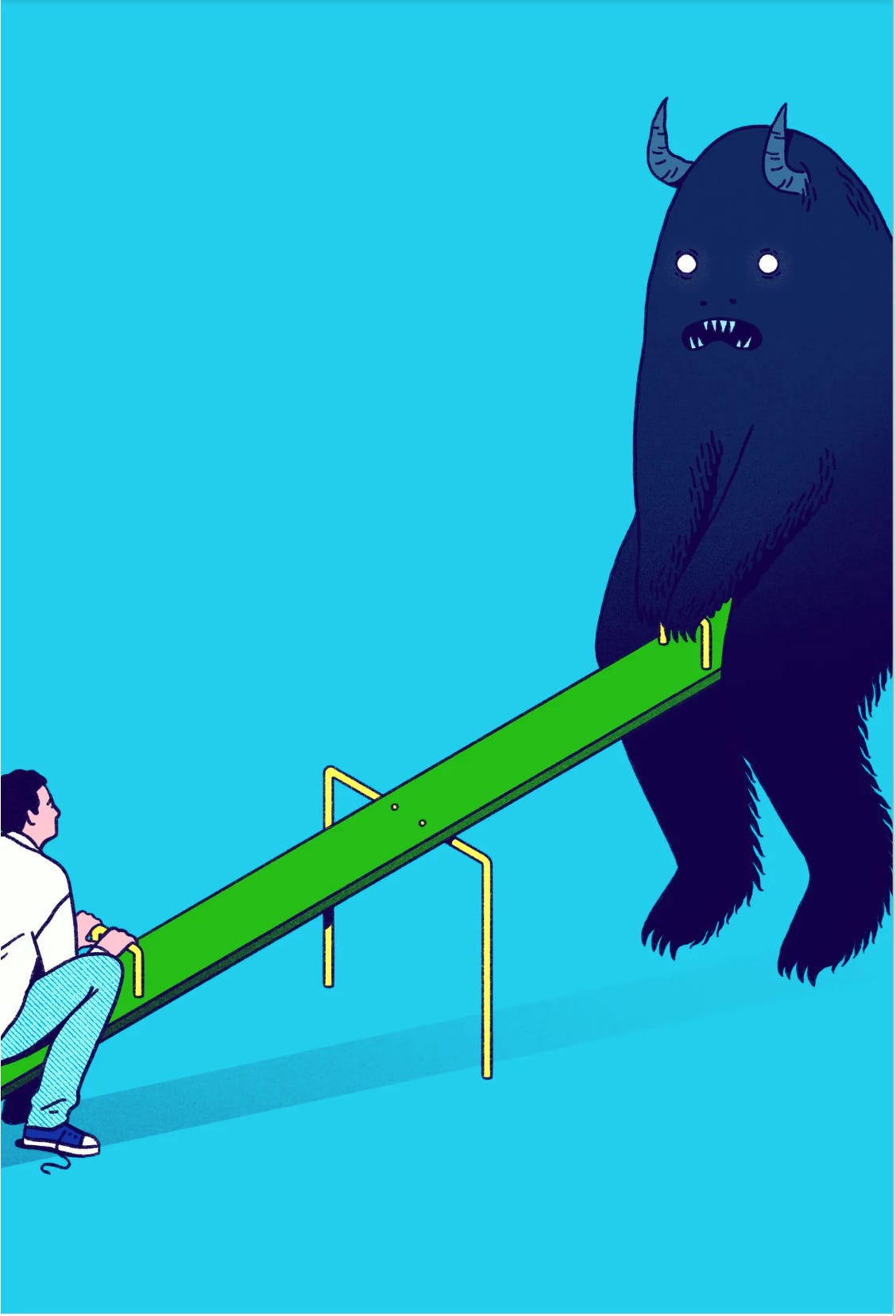
A couple of weeks ago, we published an article in The New Yorker called “Who’s the real victim?” (The picture above, from the magazine, is by the illustrator Josie Norton.)1
Our argument is that people are strongly pulled toward sorting others into villains and victims—we have problems dealing with what Primo Levi called “the gray zone.” If you are seen as a villain, your bad traits get exaggerated; if you’re seen as a victim, you are perceived as particularly good and moral.
This has awful effects. The problems with demonizing others are obvious enough, but there is an ugliness to how we think about victims as well. We tend to be harsh towards “imperfect victims” (particularly in cases of sexual assault), and this dichotomy gives victimhood a kind of unearned moral currency, one that offers both absolution and license. And further, because identifying victims tends to beget implicating villains, the more we as a society tend to slot people in as victims, the more we need to villainize people on the other side of the ledger. We suggest that this crude sorting may be worse now than it used to be, because we spend so much of our lives judging strangers we know little about. And we end with this:
The truth is that we all live in the gray zone, a psychologically awkward reality in which villainy, victimhood, and heroism can mingle in a single person. In the turbulence of the real world, we will not find perfectly monstrous people or perfectly sympathetic ones. Not among our political enemies, not among our historical heroes, not among our martyrs, not among the incels, and not among the collaborators. They are as messy, as gray, and as imperfect as the people who judge them.
It’s been less than a month, so we aren’t ready to change our views just yet. But we’ve gotten correspondence about this, and talked about it a bit, and it turns out we have more things to say, some interesting questions worth pursuing further, and one possible mistake to correct.
How social is this?
In the article, we talk about parsing the world into villains and victims as a fundamentally psychological process: Our minds—or at least the minds of modern people (see below)—can’t help but dichotomize. Give people someone who is 55% bad and 45% good, and they think “villain”; flip it, and they think “victim” (or perhaps “good guy” or “hero”). But we also say this:
There are clearly social forces at work here. Seeing complexity in villains can read as a worrisome softness, a lack of moral principle, or an indifference to victims’ suffering. Among Americans, there is little tolerance for people who talk sympathetically about the motives of the 9/11 hijackers. Likewise, anyone who talks with empathy about incels is liable to be mocked. But don’t incels also suffer? What about abusers who were themselves abused? Villain or victim? The proper response is “Why not both?” Yet such a response can feel unnatural, even repellent.
We meant this as an additional factor, but one can see it as an alternative explanation. Our minds may actually be comfortable with nuance, but when we talk to other people, we feel the social pressure to speak in absolutes. We don’t want to be squishy in condemning people who should be condemned, and we don’t want to be measured in supporting people who should be supported. We might actually be able to think, in the examples above, “they are both”, but we know better than to say this out loud.
Towards the end of the article, we note that people are more willing to afford moral nuance to fictional characters than to real-life ones, and this social account may help explain why. As Jillian Jordan suggested to us, commenting on the moral complexity of characters from the fictional worlds of novels and TV shows may be less socially costly than doing the same for real-world people whose actions have real-world stakes. It may not be that we actually see TV characters as more morally complex than real people; it’s just that, freed from the social and reputational baggage of the real world, it’s safer to say so.
Of course, the distinction between what we think and what we say may erode over time. If we spend enough time speaking in moral absolutes, perhaps we eventually come to believe them.
Cultural differences
In the article, we discuss possible cultural changes that have affected our tendency toward moral absolutism. One key paper is by Joshua Conrad Jackson and colleagues [here], who “argue that the coarsening of moral categorization reflects the social dynamics of modern life, in which we deal so often with strangers and near-strangers, and lack the information for fine-grained judgment.”
An earlier version of our New Yorker piece included a description of what was probably the most remarkable study within this paper. It looked at moral judgment not among WEIRD people in industrialized societies but among some of the world’s few remaining hunter-gatherers. Our discussion was cut for space, but we include it here:
The Hadza people of Northern Tanzania—one of the world’s few remaining populations of nomadic hunter-gatherers, who traditionally live in bands of about 30 people—maintain the more nuanced approach to moral judgment. Someone might be generous in sharing food but not necessarily the most honest; they may have a good heart, but are not the hardest working. Notably, though, even this is changing. Jackson and his colleagues also investigated the Hadza who have, in recent years, been venturing out of Hadzaland to take temporary work in the Tanzanian cities. Even after these workers returned to their traditional groups, their exposure to the moral cultures of the urban areas where people lived in much larger social networks left the workers with a flattened, generalized view of morality.
Most of the readers of this are like the Hadza who have left Hadzaland. Our social networks have steadily grown throughout history, from nomadic tribes to agricultural villages to crowded cities to the disembodied multitudes in cyberspace. With so many people to evaluate—friends, co-workers, politicians, historical figures, influencers, randos on social media—is it any wonder we tend to fall back onto simple extremes? Giving three dimensions to that many people is just too cognitively taxing.
Now there are two ways to think about how this moral judgment works within large societies, and our article doesn’t distinguish them. The less interesting possibility is that everyone applies these coarse categories to people they don’t know well. The only difference between the Hadza and us is that they don’t have as many strangers to judge. But when it comes to thinking about people we are close to, we, like the Hadza, make fine-grained moral distinctions. We recognize that our friends have complex moral profiles, and we don’t collapse them into good and bad.
But a more interesting possibility is that once we modern cosmopolitans get into the habit of coarse moral categorization, we can’t stop, and we apply it even to friends and family. Some of the data in this paper supports this more interesting possibility. The Hadza who had returned from outside work in the cities applied their more generalized view of morality even to their own campmates within the small camp. Perhaps the moral complexity would return as they grow reaccustomed to small-scale society. But most of us have spent our whole lives swimming in large societies that push us toward moral coarseness—perhaps even in how we see those dearest to us.
Moral pornography
We write:
Some stories can harden moral perception, … pushing us to dichotomize the purely good and the purely evil, as in the moral pornography of superhero comics and revenge flicks.
The phrase “moral pornography” and the comic book example were inspired (without attribution, sorry) by a great chapter by David Pizarro and Roy Baumeister called “Superhero comics as moral pornography”. In it, they argue:
Superhero comics, like other moralistic tales, are popular in part because they satisfy a basic human motivation: the motivation to divide the social world into good people and bad, and to morally praise and condemn them accordingly. … In tales of superhero vs. supervillain, moral good and moral bad are always the actions of easily identifiable moral agents with unambiguous intentions and actions. And it is these very qualities that make these stories so enjoyable.
It’s not surprising that we would cite this, as it fits so nicely with our main argument. But one of us (Azim) has been a comic book fan for years, and after some reflection, he’s not so sure this claim about superhero comics is true.
Yes, some early comic books did work this way—think of Superman vs. Lex Luthor, say—but comics are, in general, more complex than this. Pizarro and Baumeister note that the top two “supervillains” from the 2009 list “Top 100 Comic Book Villains of All Time” are Magneto and The Joker. But while Joker is as pure a villain as one can imagine—a sadistic and perverse psychopath—Magneto is … complicated.2 He is the enemy of the X-Men and has killed many innocent people. But exactly what makes him such a compelling villain is that he is also plainly a victim—a Jewish Holocaust survivor who saw his family killed in front of him. In a 2008 interview, Stan Lee said that he
did not think of Magneto as a bad guy. He just wanted to strike back at the people who were so bigoted and racist...he was trying to defend the mutants, and because society was not treating them fairly he was going to teach society a lesson. He was a danger of course...but I never thought of him as a villain.
Magneto’s tragic history was only added to his backstory in the 1980s by the writer Chris Claremont, nearly 20 years after the more one-dimensional version of the character had been introduced by Lee and Jack Kirby. Claremont, who is Jewish, as Lee and Kirby were, had spent some of his youth on an Israeli kibbutz. He reportedly modeled Xavier on David Ben-Gurion and Magneto on Menachem Begin, two very different Jewish responses to the Holocaust (and not, at least at first, on the competing civil rights philosophies of MLK and Malcolm X).
But there’s one more wrinkle to this history. Much of the moral simplicity in early superhero comics was not organic, but imposed top-down. In 1954, a US Senate Subcommittee on Juvenile Delinquency put pressure on the comic book industry, which was seen as corrupting and psychologically damaging young readers. Under that pressure, the industry created the Comics Code Authority, which set out rules for storytelling in comic books. Some were very specific: divorce couldn’t be treated humorously, clever ways of concealing weapons couldn’t be shown, and fireworks couldn’t be advertised. But others were more interesting from a moral psychology perspective. The code required the imposition of moral order (“In every instance good shall triumph over evil and the criminal punished for his misdeeds”), respect for authority (policemen, judges, and respected institutions), and what was described as “Rule #1”: “Crimes shall never be presented in such a way as to create sympathy for the criminal …”.
Some of this—including Rule #1—changed in 1971. Comics were again permitted to explore the gray zone and, as the Magneto example demonstrates, eagerly did so. The bigger point here is that, just as with the examples we took from prestige TV and cinema, superhero comic book characters are often pulled toward moral complexity—at least when that nuance isn't artificially suppressed.
Sorry about the paywall; if you want to read the piece and are not a subscriber, email either of us.
Though more recent treatments, such as the Todd Phillips’ movies, have worked to try to humanize the Joker.
Very interesting. I guess at my age, and being an Englishman, albeit one who has travelled well, comic books was such a small part of my life, and one that I didn't find particularly interesting, my childhood and teenage years was shaped by thinking, observing, and interacting with people who I knew in the village I grew up in. Consequently, I have never thought of people being other than various shades of grey.
» “Now there are two ways to think about how this moral judgment works within large societies, and our article doesn’t distinguish them. The less interesting possibility is that everyone applies these coarse categories to people they don’t know well. The only difference between the Hadza and us is that they don’t have as many strangers to judge. But when it comes to thinking about people we are close to, we, like the Hadza, make fine-grained moral distinctions. We recognize that our friends have complex moral profiles, and we don’t collapse them into good and bad.”
I think this is actually the more interesting possibility. The Hadza spend a lot of time with a band of thirty or so people (which is a lot of people to be living closely and intimately with, when you think about it) who they inevitably, due to their lifestyle, know very well, which leads them develop to a relatively nuanced mental model of “people,” which leads to relatively fine-grained moral judgements. In larger societies, you’re meeting more strangers but also you are living closely and intimately with fewer people. You may have thirty-or-so friends, family menbers, co-workers, etc. with whom you feel close (though thirty still sounds like a lot), but ultimately, you’re still spending less time with those thirty people and are not living closely and intimately with them at the very least. Your exposure to people is now much less psychologically rich: your perception of them is created at a greater distance, your model of “people” becomes coarser because of this distance, and so too do the moral distinctions you make. This would explain both the differences between the Hadza and people in WEIRD societies and the effect that going to larger societies had on the Hadza. Our mental models of “people” have simplified, so of course how we judge “people” has also simplified. And if there’s anything that feels very true to me right now about our society, it’s that we have very simple mental models of what people and their lives, in their infinite, unfathomable strangeness and variety, are really like.