

Rebecca Newberger Goldstein describes herself as fascinated by the life and work of the philosopher Iris Murdoch. So you’d think she’d be interested in what Murdoch’s husband, John Bailey, had to say about her in the three books he wrote about their marriage.
You would be wrong. Goldstein was appalled at Bailey’s descriptions of Murdoch’s helplessness as she suffered from Alzheimer’s.
How dare he! We readers had no right to be shown such scenes, and he had no right to put them before us—the cruelty of her being stripped of her words, her identity, her dignity. What’s the point of marriage, of intimacy of all kinds, if not to create a shield in which you can safely appear as you’d never let others see you, all the ways in which you, like every one of us, are pitiful, confused, and at a loss?
Goldstein stopped reading. Her reticence reminds me of the story of when, in 1929, Secretary of State Henry Stimson closed down the “Black Chamber”—the State Department’s office that intercepted and decoded diplomatic messages from other countries, including allies. Stimson later explained to an aide, “Gentlemen do not read each other’s mail.”
I don’t have this reticence. I read biographies of all kinds, and I enjoy the private correspondence of famous people. (I was touched when a friend sent me The Letters of Kingsley Amis.) I am an avid reader of Ryan Lizza’s Substack, where he details astonishing stories about his ex-fiancée, Olivia Nuzzi. (This is a level of betrayal that is worlds beyond what Bailey did to Murdoch, though Lizza argues that he’s acting in self-defense.) And I’ve spent a lot of time perusing the Epstein files, looking for mentions of my friends and enemies.
So what’s the problem here? What precisely is wrong with reading other people’s mail? Well, let’s apply the Golden Rule. Imagine that I’m your house guest, and you walk downstairs in the morning, and there I am, sitting at your kitchen table, with your laptop open, going through your correspondence—all your emails and your texts. Happy with this?
Snoops have a standard response here: WHY DO YOU CARE IF YOU HAVE NOTHING TO HIDE? Well, for one thing, people do have things to hide, and that’s totally fine. Most of us have resentments, crushes, ambitions, schemes, and opinions that we share with those we are close to, but would be horrified if everyone knew about them.
And, anyway, privacy is about more than keeping secrets. Anyone who talks to someone they love just as they would talk to a stranger is a saint, a toddler, or a simpleton. The rest of us talk differently to our friends and lovers; as Goldstein put it, one point of intimate relationships is to “create a shield in which you can safely appear as you’d never let others see you.”
If a podcast host asks my opinion on some fraught issue, I’ll carefully frame my words so I won’t be humiliated if they’re taken out of context. When I’m with someone I’m close to, I shift into a different register. I assume that they know me and like me and will be generous in interpreting what I have to say. So I bounce around ideas, push the envelope, shit-talk, and crack jokes. If I’m asked in public about what I think about a certain person, I’ll answer judiciously; when I’m talking to a friend, I’ll cut loose. (This sometimes manifests as nastiness, but it can also be a gushing admiration and affection that I’d be embarrassed to express in public.)
The world is better this way. Imagine a dystopia in which everything we say and everything we write is publicly available. (I type in your name into a certain website and get the full searchable record. Your complete web history too—no private browsing in this world.) Even if nobody is bothered by this, even if nobody mourns the death of privacy, still, this is a worse world. One thing (among many) we would lose is the chance to safely explore—to try out ideas, attitudes, and personas in a safe space before braving them in the cruel world of those who don’t love us.
Does all this mean that I’m against the release of the Epstein files, think Lizza should have his Substack taken down, or want Bailey’s books to be pulped? Not at all. For one thing, people have a right to do certain bad things. If you tell me a secret and I put it on my Substack the next day, that’s an awful thing to do, but it’s not a crime and shouldn’t be.
Also, in some cases, the benefits of exposure outweigh the costs. To take an extreme example, when the FBI listens in on two gangsters planning a hit, they are violating these men’s privacy. This is a bad thing to do, which is why there are legal hurdles to wiretapping. But it’s a really good thing to save someone from being whacked, so the math works out. Maybe the math works out for releasing the Epstein files, too.
As I said, I love reading this stuff myself. Now I wouldn’t be confessing this if I thought I was an isolated perv. But I know I’m not alone here. There is a huge appetite for tell-all biographies, leaked emails, stolen voicemail messages, tapped phone conversations, and the like. There’s nothing new here. In 1895, Oscar Wilde’s personal letters were read in open court and widely publicized, leading to his public disgrace. And I remember how excited people were to read the Royals’ private conversations many years ago.
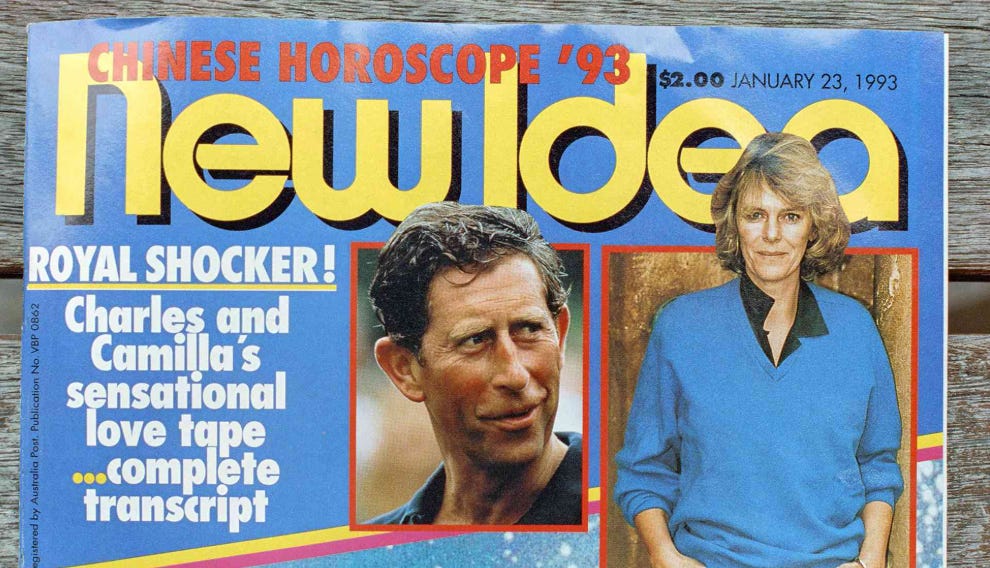
I think there are two things going on here, two appetites at work.
One is the delight we take in discovering others’ bad acts and punishing them for them. Freddie deBoer described the popularity of this law-enforcement mentality in his 2017 post, Planet of Cops.
People who narc on their neighbors are cops, and people who want to scour test scores to get teachers fired are cops, and people who want to keep an eye on trans people when they go to the bathroom are cops, obviously. … Conservatives were born cops, they always have been, they always will. … The woke world is a world of snitches, informants, rats. Go to any space concerned with social justice and what will you find? Endless surveillance. Everybody is to be judged. Everyone is under suspicion. Everything you say is to be scoured, picked over, analyzed for any possible offense. Everyone’s a detective in the Division of Problematics, and they walk the beat 24/7.
It’s subtle, but maybe you can tell that deBoer disapproves of the whole thing. I get this. Over the years, I’ve seen a lot of people he calls “little offense archaeologists” ruin people’s lives for what seem to me fairly minor offenses.
But I’m more pro-cop than deBoer is, and so this impulse bothers me less. Anyone who thinks about how good actions are sustained has to give credit to punitive impulses that make immoral behavior costly, thereby ensuring that nice guys don’t finish last. So long as there are criminals, the world needs cops. And so long as there are free-riders, sleazebags, creeps, and assholes—and so long as all of us are sometimes tempted to treat others badly—the world is better off if we are all inclined to do some policing of our own. It’s not wrong to be a cop, then, it’s just wrong to be a bad cop.
Anyway, the appetite for moralistic punishment is not the main draw of the Epstein files, or Lizza’s Substack, or Bailey’s depiction of his wife’s mental decline. There’s something more general going on here.
A while ago, there was a paper published called Monkeys pay per view:
Adaptive valuation of social images by rhesus macaques. It reported a study in which male rhesus monkeys were hooked up to an apparatus that allowed them to choose, by moving their heads, to either receive some sweet fruit juice (delicious!) or to look at a picture.
It turned out that they would give up juice—they would “pay”—to get to look at pictures of female monkey hindquarters. They would also pay to see pictures of the faces of high-status male monkeys they knew. If the first finding captures the lure of Pornhub, the second is about why the appeal of People magazine or TMZ.

We are fascinated by high-status people, and our fascination intensifies when we see them humbled. It’s not just prurient curiosity, then; it’s also a delight in bringing them down to our level.
The pleasure we take here is similar to the pleasure some take in the consumption of leaked sex tapes and stolen nude pictures from celebrities’ phones. Literally and figuratively, we want to see these people naked. The non-consensual nature of these releases makes them more appealing, not less, because it increases the feeling of power that we get.
Should you be ashamed of reading other people’s mail? Not if you’re a federal investigator investigating a crime or (contrary to what Henry Stimson believed) part of your country’s intelligence apparatus. Not if you’re a scholar exploring the lives of historical figures. But the rest of us? Well, ask yourself this: Should you be ashamed of looking at leaked sex tapes and stolen nude pictures? It’s much the same impulse, and so the answer is probably the same.
I love that the opening lines of the rhesus monkey study are:
"Individuals value information that improves decision making. When social interactions complicate the decision process, acquiring information about others should be particularly valuable."
Doesn't this sum up a big part of what Epstein et al were up to, exchanging information about powerful peers and their movements?
On reading the title I remembered when my grandparents used to say “be careful what you write” when sending letters to family in East Germany/ Lithuania because they thought letters were intercepted in the communist regimes. How far have we come. It’s even scarier now with our current technology.