

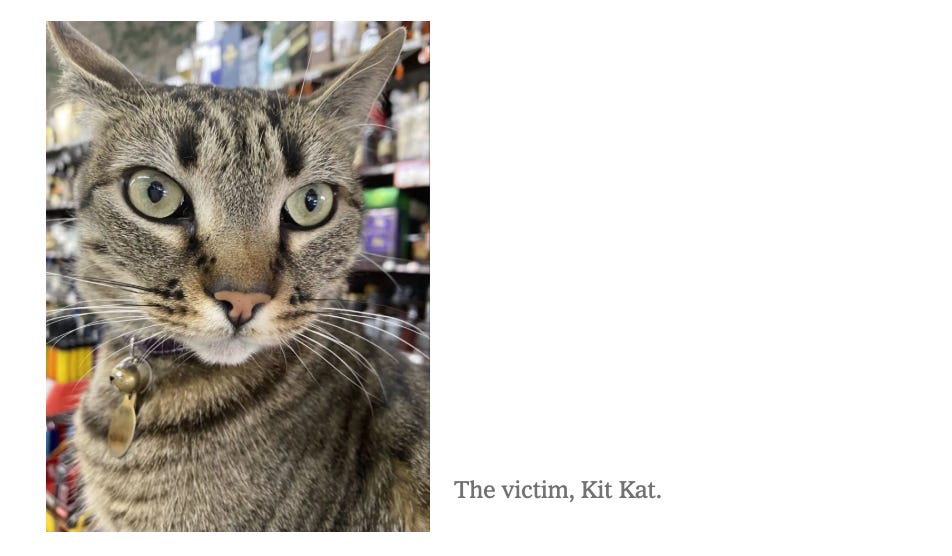
Last year, the New York Times eulogized a dead kitty in a front-page article.
At Delirium, a dive bar in San Francisco’s Mission District, the décor is dark, the drinks are strong, and the emotions are raw. The punk rockers and old-school city natives here look tough, but they are in mourning.
Kit Kat used to bar-hop along the block, slinking into Delirium for company and chin rubs. Everybody knew the bodega cat, affectionately calling him the Mayor of 16th Street. Kit Kat was their “dawg,” the guys hanging out on the corner said.
But shortly before midnight on Oct. 27, the tabby was run over just outside the bar and left for dead. The culprit?
A robot taxi.
A couple of weeks later, the Times returned with a second article revisiting the community reaction and featuring a video of a Waymo taxi running over Kit Kat.
The death of Kit Kat was awful, but what’s worse are those rare cases when driverless cars kill people. Or when new technologies have other tragic consequences, as in the stories of AI “therapists” that allegedly encourage teens to commit suicide, or at least don’t work hard enough to stop them from killing themselves. Or in cases where people die due to mistaken AI-generated medical diagnoses.
What should we make of all this death by AI?
One thing these failures show us is that current AIs are imperfect—actually, they are often surprisingly dumb—and so they challenge the view that they’ve already achieved AGI or superintelligence. This is a point that my friend Gary Marcus makes over and over again, and he’s doing the Lord’s work here.
They also point to specific design flaws that should be addressed. In the case of the Waymo fatality, one suggestion mentioned in the article is that the company should install cameras under the taxis. If AI sycophancy causes some of its users to develop delusions, we should work to dial down the sucking up.
Some people make a stronger implication, though. They see these failures as grounds for shutting down access to the products. Individuals shouldn’t use those kitty-crushing Waymos, and governments should take them off the streets. You shouldn’t get medical advice from AIs; you shouldn’t have AIs talk to your teenager.
This is apparently a tempting conclusion to draw. I think this is partly because most newspaper articles and scientific papers on AI-related death ask questions like: Do Waymos ever run over cats? Does Claude ever give bad medical advice? Does ChatGPT ever encourage teenagers to kill themselves? Since the answers are yes, yes, and probably yes, people react accordingly.
But these are the wrong questions. What we should ask instead is how well these AIs perform compared to the alternatives. The importance of comparison is obvious in other avenues of life. If you’re shopping for a new car and you’re worried about safety, you don’t ask, “Do people ever die when driving a Honda Civic?” You ask about the Honda Civic's safety record compared to that of other cars you might buy. If you are a sociologist interested in policing in Latin America, you don’t ask “Is there murder in Mexico City?” Rather, you look at how the murder rate in Mexico City has changed over time or compare it to that of other cities.
Why don’t we do the same with new technology? I think it’s because we are swayed by two pretty major failures of rationality.
The first is that we tend to give salient and disturbing cases too much weight. In a discussion of self-driving cars, Phil Koopman writes.
All the statistical analysis in the world pales in comparison to a picture of a kid on a sled in a crosswalk (hypothetically) having been hit because that was a “rare edge case” that a robotaxi had not been trained to handle.
I agree with Koopman that people really are swayed by such cases. I also think it’s a dumb-ass gut response that we should try our best to get over. It’s the same impulse that makes parents keep their children home after a school shooting on the other side of the country. It’s what makes people think immigrants are especially violent when cynical politicians tell lurid stories of immigrant crime.
To see what’s going wrong, here is Scott Alexander on all the evidence that cardiologists are assholes.
It takes a special sort of person to be a cardiologist. This is not always a good thing.
You may have read about one or another of the “cardiologist caught falsifying test results and performing dangerous unnecessary surgeries to make more money” stories, but you might not have realized just how common it really is. Maryland cardiologist performs over 500 dangerous unnecessary surgeries to make money. Unrelated Maryland cardiologist performs another 25 in a separate incident. California cardiologist does “several hundred” dangerous unnecessary surgeries and gets raided by the FBI. …
Consider the sexual harassment. …
And Alexander goes on and on. The point? Alexander presents this as an example of what Alyssa Vance calls the Chinese robber fallacy: “where you use a generic problem to attack a specific person or group, even though other groups have the problem just as much (or even more so).” Yes, cardiologists do bad shit all the time, but if this makes you hate on them, you are responding to the answer to the wrong question. We shouldn’t ask: “Do cardiologists do bad things?” We should ask: “Are cardiologists any worse than podiatrists, oncologists, and so on? Or, for that matter, professors, accountants, and baristas?” (Probably not.)
Similarly, we should ask about immigrant crime vs. the crimes of non-immigrants, deaths by school shootings vs. traffic accidents … and AI-caused deaths vs. human-caused deaths.
The second failure of rationality is a status quo bias: an unseemly attachment to the way things currently are; an irrational overweighing of the cost of the new. We effectively end up comparing a new technology to perfection, so it’s no wonder it comes up short.
To shake this bias loose, let’s flip things. Imagine a world where all taxis were self-driving and always have been. How would we react if someone suggested replacing these with human-driven cars? I can see the New York Times articles now, indignantly pointing out that humans drive while drunk, that human taxi drivers sometimes assault their passengers. Here’s this argument in the form of billboards.
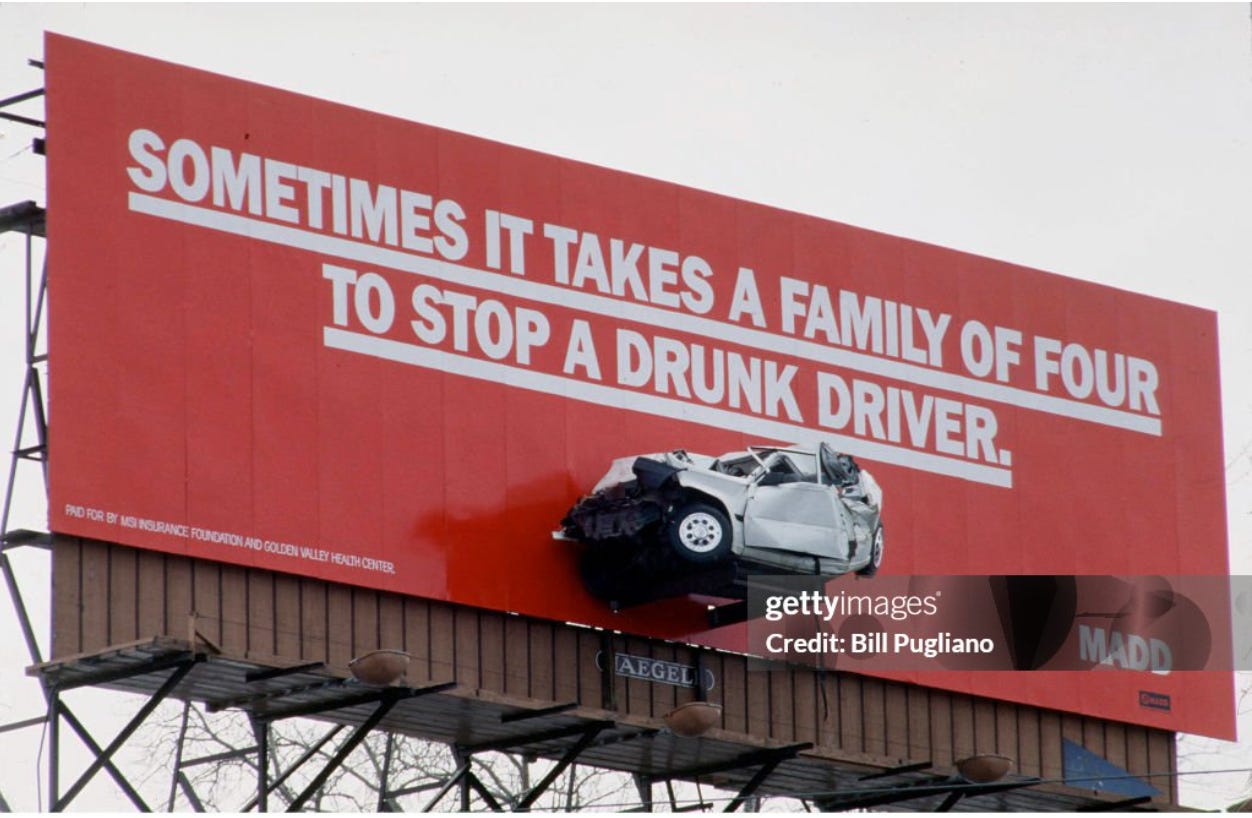
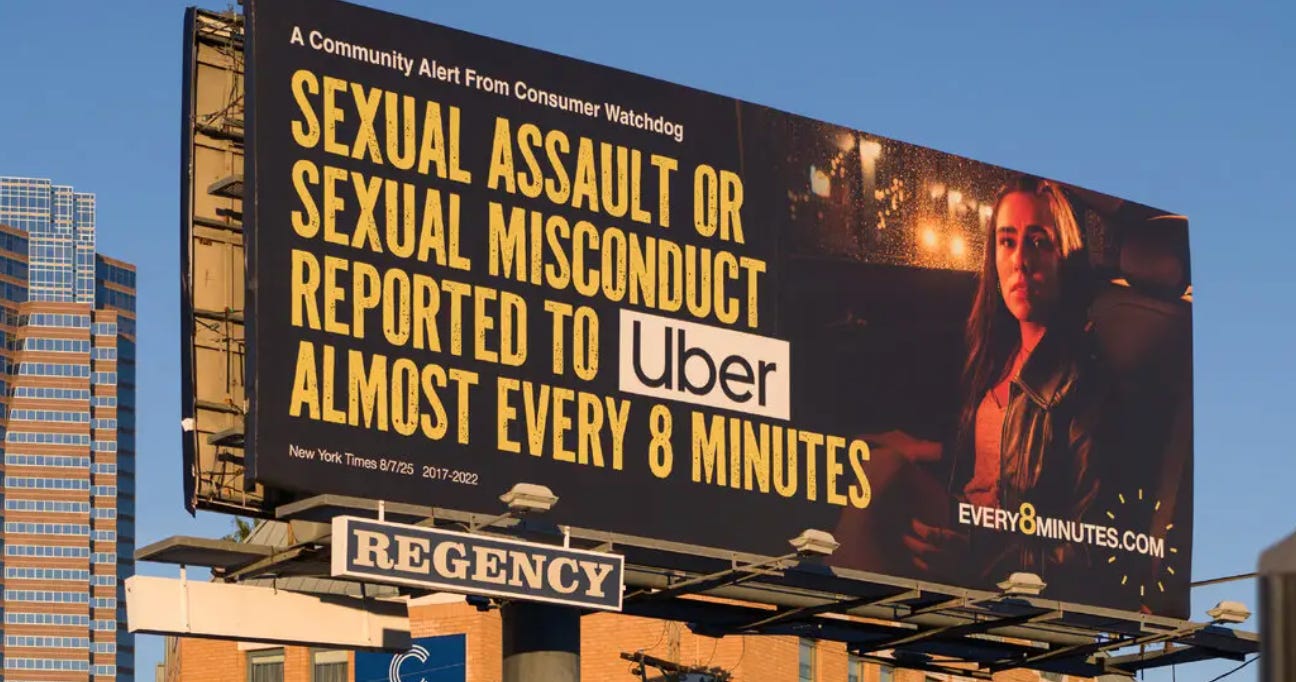
Writers for the New York Times would also point out that the data suggest that driverless cars are safer—they kill and injure fewer people.1 Suppose that shifting from all-AI taxis to all-human taxis in a city like San Francisco will cause 5 more people to die, on average, each year. Surely, those who successfully campaigned for such a shift would have blood on their hands. Now, maybe there are other advantages to moving to human drivers, such as creating new jobs or not creeping people out (one of the big arguments against Waymos, apparently, is that they are creepy), but such advantages would have to be pretty substantial to offset those extra five corpses.2
Now go back to the world as it is. Call me a simple-minded consequentialist, but it does seem that those who work hard to keep Waymos off the roads bear some moral responsibility for all of those extra deaths that we’re now stuck with, year after year.
My point here isn’t to argue for driverless taxis. I do think the benefits of Waymos over human drivers are overwhelming (and they don’t just have to do with lives saved; here is Caroline Sutton on other advantages these vehicles have, particularly for women). But maybe I’m wrong! My point is that the question of whether to adopt (or abandon) a certain technology involves cost-benefit trade-offs, and you can’t think properly about this unless you properly compare it to the alternatives.
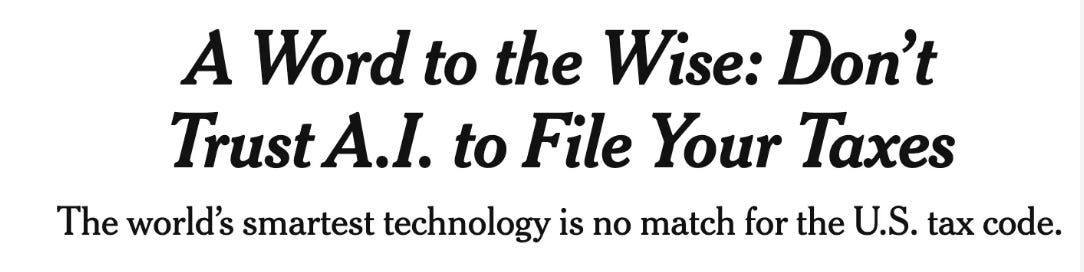
It’s not just cars. Here is a NYT article from a couple of months ago on using AIs like Chat and Claude to do your taxes. According to experts, they suck. This is good to know, but still, would it have killed the Times to also test the performance of a commercial tax-preparation company like H&R Block just to see who sucks more?
Articles in scientific journals also ask the wrong questions. Here, Gary Marcus summarizes four published studies that find that chatbots make medical mistakes and that people often misuse the advice they give.
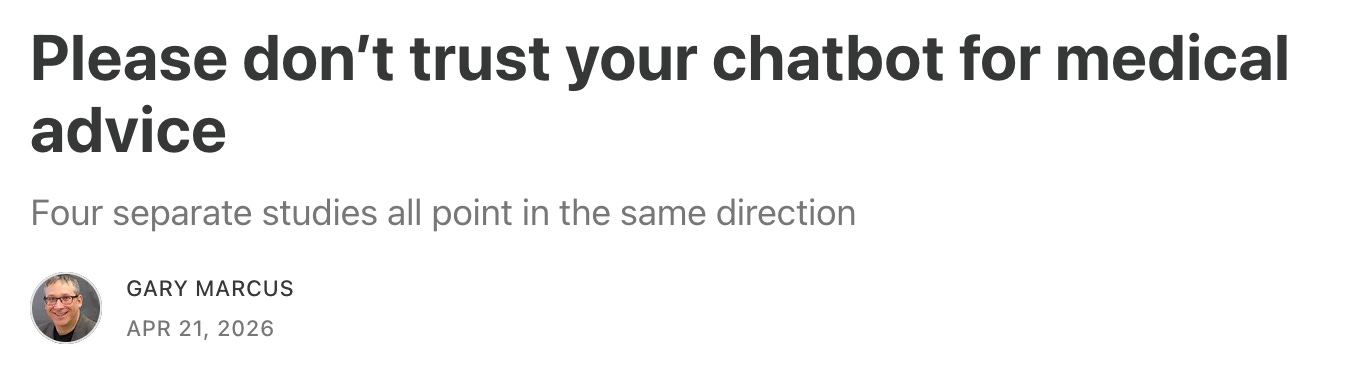
This is worth knowing, especially given Gary’s above-mentioned interest in showing that AIs are not as omniscient as many believe. But before advising people not to trust chatbots' medical advice, I’d love to see studies comparing chatbots with human doctors. (Any guesses as to how often human doctors make mistakes that kill and maim people? Check the footnote for one estimate.3)
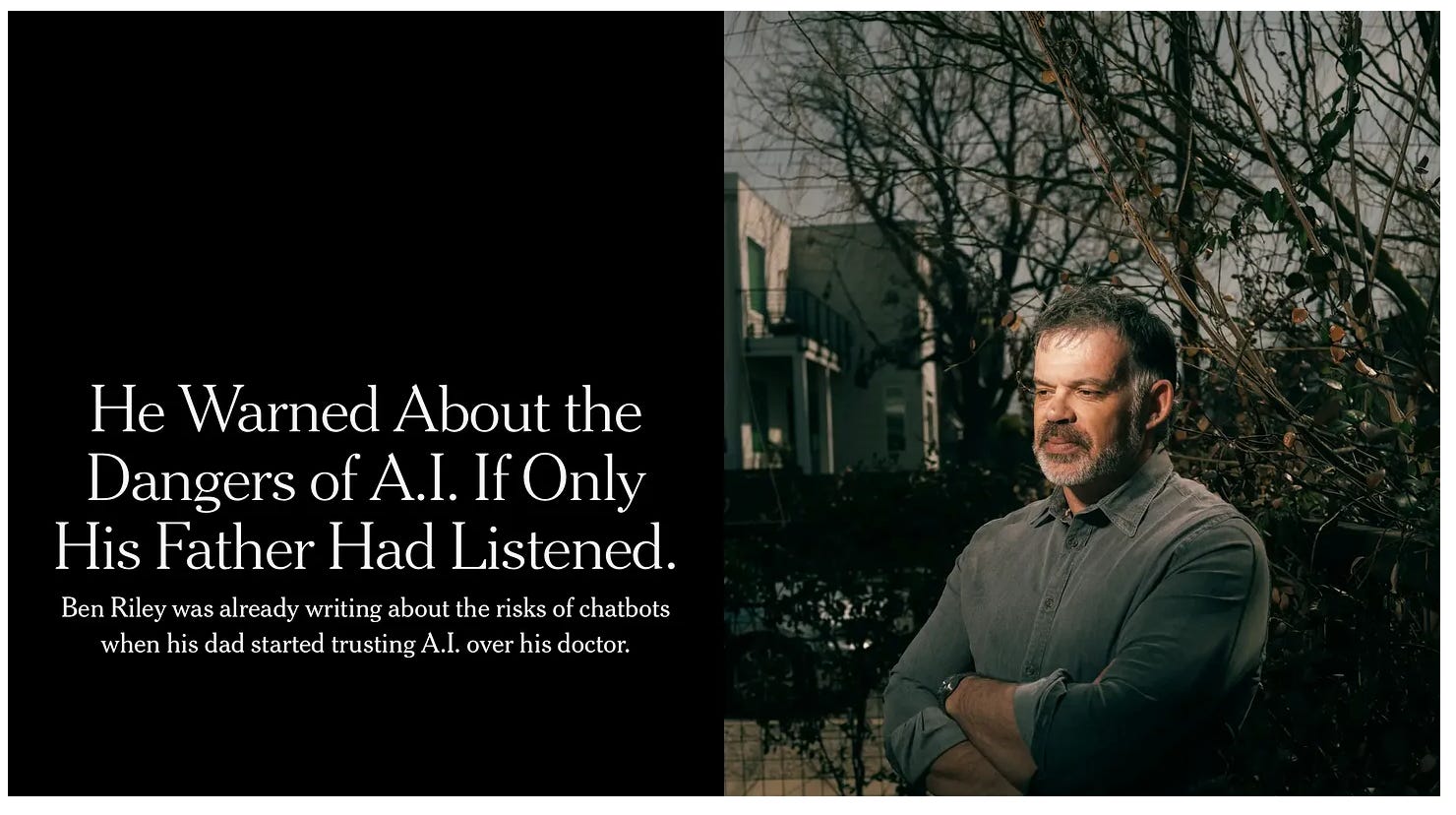
Gary ends his discussion by linking to what he calls a “long moving story” (here) about how the father of a New York Times writer got tragically bad advice from an AI on treatment for his leukemia. I believe it, and it’s terrible. But it’s sure not hard to find long, moving stories about when doctors screw up in a major way. (I have a few; I bet you have some too.) Or, on a cheerier note, it’s not hard to find cases where AIs save lives by diagnosing problems that doctors miss, like here.
I wrote a partial draft of this post a long while ago, but gave up on it. Not because I felt the argument was weak, but because I worried it was obvious. Who would disagree that it’s wrong to focus too much on single dramatic cases; who would deny that you have to compare AIs to the alternatives? Even in the original Kit Kat article, the writer, Heather Knight, gives voice to those who would ban Waymos, but she also hints (at least to my ears) that she thinks they’re kind of dopey. (At one point, she talks about all the cats killed by human drivers over the last few weeks and dryly remarks: “None of them seemed to have prompted media coverage, shrines or meme coins.”)
What brought me back to this issue is that over the last year or so, I’ve been deep in the weeds on the question of AI companions. My own feelings about them are decidedly mixed—I think they can greatly improve the lives of some people, but can be ruinous for others. Here, as in much of life, we face difficult problems involving complex tradeoffs.
But I see so many discussions of the topic that follow a simple-minded Kit Kat logic: “I heard a story about an AI companion that harmed someone, so we have to ban them.” And it’s not all on the anti-side! You also get: “I heard a story about an AI companion that helped someone, so we can never restrict them in any way.”
All this drives me crazy, and so I resurrected this somewhat grumpy post.
For a good discussion of the data here, including some interesting arguments against driverless cars, I recommend Ross Douthat’s interview with Andrew Miller.
Just to get this out of the way, I’m aware that none of this matters to the law. If a Waymo suddenly runs onto a sidewalk and kills someone, the company will be sued for a bazillion dollars (and under some circumstances, Waymo executives might face criminal charges). It won’t win points with judges or juries to say, “Sure, we killed that guy, and that’s on us, but look, on average, we kill fewer people than regular taxis, so we’re a net positive.”
The number is small because we’re only considering taxis and a single city. A nationwide shift from human drivers to AI drivers would likely save thousands of lives.
Thanks for the article, Paul. As a daily user of Ai to answer many of the questions I have, my experience suggests that it is amazingly accurate. Granted, as a musician I am looking for mostly technical help with recording engineering, and how to troubleshoot technical issues. What has been interesting is that I have found near perfect accuracy in answering questions I have had about medicine, household repairs, ideas for songs, analysis of song writing techniques, financial questions, demographics, Writing assistance (amazing) and creation of great looking posters and advertising for events in just a minute or so. I have also owned a Tesla Model 3 with full self driving for the last 7 years-my experience--it is considerably safer than human controlled cars. I can confidently say that it has helped me avoid a number of accidents, and makes driving more pleasurable.
What I hear many people my age (I'm 66) saying is that Ai is usually wrong. What's interesting is that when I ask the question, have you ever used Ai, the answer is generally no.
Here's the part that actually changed how I trade stocks: the AI doesn't have my nervous system.
When a position drops 8% before lunch, I feel it in my chest. My hands want to sell. That urge has nothing to do with whether the thesis broke — it's just fear looking for an exit. The AI feels none of that. It looks at the same red number and asks the boring, correct question: did anything actually change, or is this just noise? Most days it's noise. Left alone, I'd have sold into it anyway.
That's the real value. Not that it's smarter than me — it's often not. It's that it's not scared at the moment I am. It gives me a second read from outside my own panic, and half the discipline of trading is just having something in the room that isn't flinching.
So when people say "get AI out of X," I mostly hear someone who's never actually stress-tested the alternative. The alternative to the calm tool is the emotional human — and the emotional human is exactly who loses money at 9:30am. Keeping the emotional human and tossing the calm tool because it's imperfect isn't the careful choice. It's the lazy one — you're just defending what you're used to.
The tool's flawed. I check it constantly. But it doesn't flinch, and that alone makes me better than I am alone.
AI's here to stay. The only real question is whether you're disciplined enough to use it well — and the people who can't get past "but it made a mistake" have already answered that about themselves.